
Millions of Dollars
Recovered for Our Clients.
Recovered for Our Clients.
Let Us Fight for the Money You Deserve!











If you were diagnosed with silicosis and worked with granite, quartz and other fabricated stone, you may qualify for compensation. You may have spent years turning stone slabs into kitchen countertops, bathroom vanities, and finished surfaces. Now, a silicosis diagnosis may leave you wondering whether you can keep working, how you will afford treatment, and what will happen to your family. If your lung disease developed after breathing silica dust, a free case review may help identify whether a responsible company can be held accountable.
The Law Offices of Jason Turchin can review potential silicosis lawsuits involving quartz countertop fabrication, engineered stone, granite work, and other occupational silica exposures. We can investigate matters in Florida, New York, and New Jersey and collaborate with attorneys in other states, including Illinois co-counsel, when appropriate.
Contact us at 800-337-7755, speak with our live chat agents, or request a free consultation. You do not need to know which company may be responsible before contacting our firm.
For many workers, the connection between dust exposure and lung disease becomes clear only after medical testing. A cough that seemed ordinary may persist. Tasks that once felt manageable may become exhausting. Some people receive a diagnosis after leaving the job where they were exposed.
Silicosis develops when inhaled respirable crystalline silica causes inflammation and scarring in the lungs. The resulting damage is often permanent, and the disease can be disabling or fatal. There is no known cure, although doctors can evaluate treatment and support options based on the patient’s condition.
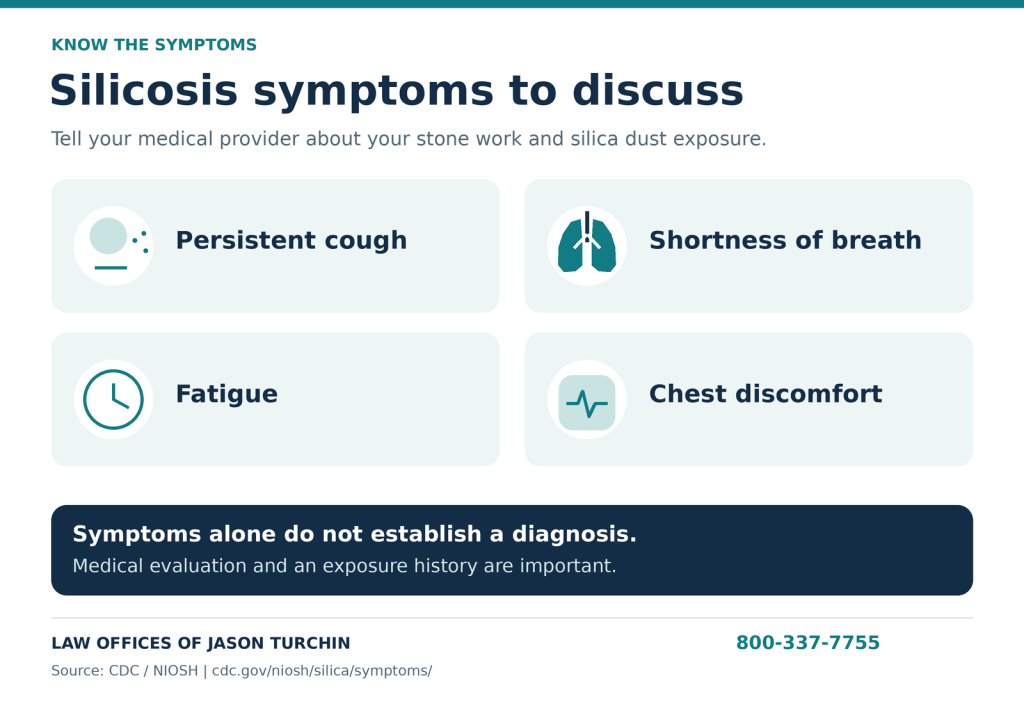
The CDC’s information on silicosis symptoms and diagnosis identifies cough, shortness of breath, fatigue, and chest pain as possible symptoms. Diagnosis requires medical evaluation, an exposure history, and findings consistent with the disease. Symptoms alone do not establish that someone has silicosis.
If your doctors are investigating unexplained lung problems, tell them about the materials you handled, the tasks you performed, and the dust conditions at each workplace. That history may matter even when the exposure occurred years ago.
The danger comes from breathing dust released during work with silica-containing materials. Sawing slabs, grinding edges, drilling openings, and polishing surfaces can put fine particles into the air. Dust may also become airborne during cleanup or when nearby workers perform these tasks.
Engineered stone is often sold as quartz, manufactured stone, or artificial stone. Some products contain up to 95 percent crystalline silica. That high concentration can make controlling exposure especially important during fabrication and installation.
Natural stone can also be relevant. Granite contains crystalline silica, and working with it can create a harmful exposure. A worker who handled several types of stone should describe the full history rather than assuming only quartz products matter.
The OSHA/NIOSH alert for countertop manufacturing, finishing, and installation addresses exposure in shops and at installation sites. The risk concerns dust-generating work, which differs from ordinary use of an intact countertop in a home.
A diagnosis is an important starting point, but a lawsuit also requires evidence establishing legal responsibility. Our product liability lawyers can examine how a worker’s exposure, the products involved, and the medical findings fit together.
A review generally focuses on three questions:
Potential allegations may concern an unreasonably dangerous product design, inadequate warnings, insufficient handling instructions, or negligent conduct. Whether a particular theory is available depends on the jurisdiction and evidence. A company’s involvement in the stone industry does not, by itself, establish liability.
You can also review our product liability FAQs for an introduction to claims involving allegedly dangerous products.

A case investigation may consider what companies knew about the risks, what warnings accompanied the products, and what information reached the people doing the fabrication. Historical labels and safety data sheets can be important because the materials and instructions available during your employment may differ from those available today.
Workplace conditions also deserve careful attention. Relevant questions may include whether tools used water, whether ventilation captured dust, whether exposure levels were measured, and whether workers received appropriate training and respiratory protection.
The CDC’s silica and worker health guidance describes a layered approach to protection. Dust controls and protective equipment serve different roles. The fact that a worker wore a mask or used a wet tool does not, without further investigation, establish what exposure occurred.
Possibly. An occupational illness may qualify for workers’ compensation benefits while also raising questions about a third party’s responsibility. These are separate legal paths, often with different requirements and available remedies.
Workers’ compensation laws generally restrict civil lawsuits against employers, subject to exceptions. However, depending on applicable law, those restrictions may not prevent a claim against a responsible company outside the employment relationship.
If you already have a workers’ compensation attorney, benefits claim, or settlement, disclose that information during your consultation. A third-party claim may require coordination with existing benefits and consideration of reimbursement rights or liens. Before resolving either matter, the effect on the other should be evaluated.
Silicosis may affect much more than a worker’s current medical bills. Someone who previously performed physical labor may lose the ability to continue in the same trade. Medical appointments, oxygen needs, and limitations on daily activity may place additional demands on the household.
Depending on the claim and governing law, recoverable losses may include:
There is no fixed payment for a silicosis lawsuit. Evaluating a potential recovery requires consideration of the medical evidence, liability, applicable defenses, and individual losses. An online settlement estimate cannot replace that analysis.
Do not return to a hazardous work area or handle dusty materials to collect evidence. Records, witnesses, and other sources may help establish the history without creating additional exposure.
Missing paperwork does not necessarily end the investigation. A former coworker may remember suppliers. Photographs may show slab labels. Purchasing records may identify products. Tell us what you remember, including any gaps or uncertainty.
If a loved one died from silicosis, the family may have questions about the person’s work history and whether the death could support a legal claim. Our wrongful death attorneys can evaluate potential options for the estate and eligible survivors.
The proper person to bring a claim, available damages, and filing deadlines depend on state law. Medical records, employment information, and documents concerning the cause of death may assist with the review. Families can contact us even if they are still gathering those materials.
Silica exposure does not always occur in a single place. A fabricator may work at several shops, install countertops across state lines, or move before receiving a diagnosis. Products may also pass through manufacturers and suppliers located elsewhere.
We can evaluate potential silicosis matters across the United States, including Florida, New York, and New Jersey, while working with attorneys across other jurisdictions, including Illinois and other states. Depending on the case, a partner firm or local counsel may participate in the representation.
Our legal team can help consider where a claim may properly proceed and which law applies. If we accept a matter, the engagement documents identify the participating firm or firms and explain the fee arrangement.
The Law Offices of Jason Turchin handles personal injury, product liability, wrongful death, and other civil claims. Our approach includes examining potential responsibility, preserving relevant evidence, and evaluating the practical consequences of a serious injury.
Jason Turchin has received recognition that includes:
The firm has maintained an A+ BBB rating annually from 2014 through 2026 and received the Martindale-Hubbell Client Champion Platinum Award in 2026. Recognition and past outcomes do not predict the result of a future claim.
Initial consultations are free. For cases accepted on contingency, you owe no attorney’s fees or costs to our firm unless we recover compensation. A written agreement explains the terms that apply to your representation.
Include every relevant workplace in your history. Exposure may have occurred at multiple jobs, and the investigation may need to identify which products and conditions were present at each location.
It may still be possible. Other sources, such as supplier records, former coworkers, photographs, and employment documents, may provide useful information. Closure of the shop does not automatically answer whether another company could be responsible.
No. A transplant is not a prerequisite for a consultation. Workers with different degrees of diagnosed disease can request a review. The condition’s severity and expected course may affect the evaluation.
No. Each worker’s exposure, diagnosis, and losses may require individual attention. Whether a case should proceed independently or within coordinated litigation depends on the circumstances and available procedures.
Yes. A family member can help organize work history and other information. We may need the worker’s authorization to discuss private records or take further steps on the worker’s behalf.
There is no reliable standard timeline. Medical review, product identification, expert work, court schedules, and the parties’ positions can affect the process. We can discuss what the investigation may involve after reviewing the available facts.
Yes. Begin with your diagnosis, treating providers, and what you know about your work. We can explain which additional records may be useful and how they may be obtained with appropriate authorization.
You do not have to reconstruct years of exposure on your own before seeking legal help. If stone work or another silica-related occupation may have contributed to your silicosis, we can discuss the circumstances and whether further investigation is appropriate.
Call 800-337-7755, start a conversation through our live chat, or send a consultation request to the Law Offices of Jason Turchin. The initial case review is free.
