
Millions of Dollars
Recovered for Our Clients.
Recovered for Our Clients.
Let Us Fight for the Money You Deserve!











Top-rated product liability lawyer Jason Turchin and the Law Offices of Jason Turchin handled one of the first ever injury claims in the U.S. involving an AI-powered wheelchair after it injured someone. Artificial intelligence is transforming mobility technology, offering new opportunities for people with disabilities and limited mobility. Today’s powered wheelchairs may include features such as obstacle detection, collision avoidance, automatic braking, voice controls, navigation assistance, and smartphone connectivity. While these innovations may improve independence for many users, they may also introduce new risks if the technology fails.
A powered wheelchair is more than a convenience. It is often an essential medical mobility device. When an AI-assisted wheelchair malfunctions, the consequences can be severe. A software error, defective sensor, braking failure, or unexpected movement may result in serious injuries not only to the wheelchair user but also to caregivers, pedestrians, and others nearby.
If you or a loved one suffered injuries because an AI-powered wheelchair malfunctioned, you may be entitled to compensation. The Law Offices of Jason Turchin represents individuals injured by defective products and medical devices, including emerging technologies that rely on artificial intelligence. Jason Turchin was one of the first lawyers ever to have a website, and developed the first app for lawyers more than 15 years ago. His firm remains on the cutting edge of emerging technologies, bringing their experience in technology to the field of product liability litigation. He was also one of the first attorneys to publish a research paper on product liability claims and autonomous vehicles, more than 10 years ago.
AI-powered wheelchairs combine traditional powered mobility equipment with advanced technology designed to assist users during everyday travel.
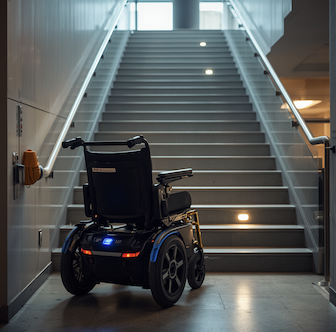
Depending on the manufacturer and model, these wheelchairs may include:
Many of these features are intended to improve safety and increase independence. However, no technology is immune from design flaws, manufacturing defects, software errors, or hardware failures.
Unlike traditional wheelchairs, AI-powered models may rely on complex interactions between software, electronics, cameras, sensors, batteries, and mechanical components.
Potential failures may include:
Even a brief malfunction can place a vulnerable user in immediate danger.
Several types of incidents may lead to serious injuries.
If obstacle detection or edge-recognition systems fail, a wheelchair may continue moving toward:
These incidents may cause catastrophic injuries.
Some users have reported battery powered mobility devices that suddenly moved faster than expected or continued moving after controls were released. A defect could cause an AI-powered mobility device to malfunction.
Unexpected acceleration may lead to:
Automatic braking systems are designed to stop the wheelchair when hazards are detected.
If braking fails, the wheelchair may collide with:
Artificial intelligence often depends on accurate data.
If cameras, radar, lidar, ultrasonic sensors, or other detection systems fail, the wheelchair may incorrectly interpret its surroundings.
Examples include:
Many AI-powered wheelchairs use rechargeable lithium-ion battery systems.
Potential battery-related failures may include:
Battery failures may strand users in unsafe locations or contribute to additional injuries.
Wheelchair accidents may result in serious injuries because users are often medically vulnerable.
Potential injuries include:
Recovery may require surgery, rehabilitation, assistive care, and significant lifestyle adjustments.
Possibly. If an AI-powered wheelchair was defectively designed, manufactured, or marketed, product liability laws may allow injured consumers to pursue compensation.
Potential legal theories include:
The wheelchair’s design may have created unreasonable safety risks.
Examples may include:
Even a safe design may become dangerous if manufacturing errors occur.
Examples include:
Manufacturers may have a duty to provide adequate warnings and instructions regarding known limitations or risks.
Claims may involve allegations that users were not adequately informed about:
Unlike traditional wheelchairs, AI-powered devices rely heavily on software.
Potential issues may include:
Depending on the facts, several parties may potentially share responsibility.
These may include:
Determining liability often requires reviewing both the physical equipment and the software controlling it.
If an AI-powered wheelchair may have contributed to an injury, consider taking the following steps.
Prompt medical treatment protects both your health and important medical documentation.
Do not repair, modify, or discard the device if possible.
The wheelchair itself may become important evidence.
Preserve:
Take pictures of:
An attorney can help investigate whether a product defect contributed to the accident and work to preserve critical evidence before it is lost.
Depending on the circumstances, compensation may include:
Every claim depends on its specific facts and applicable law.
These lawsuits often involve sophisticated technical issues, including:
Multiple companies may have participated in designing, manufacturing, programming, or servicing the wheelchair.
The Law Offices of Jason Turchin can evaluate these complex product liability cases and work with qualified professionals when technical analysis is needed.
Possibly. If a defect contributed to your injury, you may have grounds to pursue a product liability claim.
No. Many product liability lawsuits involve products that have not been recalled.
Software updates may become important evidence and should be preserved whenever possible.
Depending on the circumstances, caregivers who are injured by a defective wheelchair may also have legal rights.
The deadline varies depending on state law and the facts of the case. Consulting an attorney promptly can help preserve important evidence and protect your legal rights.
Artificial intelligence has the potential to improve mobility and independence for many people, but safety should remain a priority. When an AI-powered wheelchair fails and causes serious injuries, manufacturers and other responsible parties may be held accountable under product liability laws.
If you or someone you love was injured because an AI-assisted wheelchair malfunctioned, the Law Offices of Jason Turchin can help you evaluate your legal options and determine whether you may have a claim.
📞 Call (800) 337-7755 or visit www.VictimAid.com for a free consultation.
